


For Practice Managers in UK primary care, the fastest way to manage the “8 AM rush” is to remove it entirely. AI-driven triage systems like Klinik act as a digital air traffic controller for healthcare sorting, prioritising, and directing patient requests to the right professional the first time.
The 8 AM Rush: A System Under Strain
Every morning, thousands of patients hit redial at exactly 8:00 AM, all competing for the same limited number of GP appointments. The process is frustrating, inefficient, and fundamentally inequitable rewarding whoever calls first, not whoever needs care most.
This model no longer works for modern practices facing staff shortages, rising demand, and increasingly complex case mixes. Klinik’s AI system offers a different approach turning this daily scramble into an orderly, data-driven flow.
AI as an Air Traffic Controller for Healthcare
Klinik’s technology mirrors how an air traffic control tower operates. Instead of letting every plane circle the airport waiting for a single runway (the GP), it intelligently directs each to the right destination whether that’s a nurse, pharmacist, physiotherapist, or GP. Here’s how it works in three precise steps.
1. How the “Air Traffic Controller” Works
Step 1: Gathering Structured Patient Information
Whether patients contact the practice online, by phone, or in person, Klinik collects a standardised set of medical and contextual data.
- Online: Patients complete a structured Klinik Access form.
- By phone: Receptionists use Klinik Connect to capture the same questions.
- In person: Walk-ins are logged through the same workflow.
This consistency means every case starts with complete, accurate information eliminating guesswork and ensuring all patients are treated equally, regardless of channel.
Step 2: The AI “Digital Brain” Assesses Need
Once submitted, the data passes through Klinik’s CE-marked clinical AI engine. Trained on thousands of real-world consultations, it functions as a digital triage nurse with infinite recall.
It performs two key actions:
- Recognises over 1,000 conditions, from common infections to mental health and paediatric cases.
- Ranks urgency and care type, recommending whether a patient sees a GP, nurse, pharmacist, or is safe for self-care.
This ensures decisions are based on clinical need, not on who reached the receptionist first.
Step 3: Directing Patients to the Right “Runway”
Finally, Klinik routes cases intelligently to the right professional. A pharmacist handles medication queries, physiotherapists take musculoskeletal cases, and GPs focus on complex problems.
This transforms the workflow from a single queue into a coordinated, multi-lane system that gets everyone care faster.
2. Real-World Impact: Data That Speaks for Itself
For Patients: Faster and Fairer Access
With AI triage, practices move from first-come, first-served to need-first. Every query whether online or by phone is assessed with equal precision.
- 70% of patient contacts are resolved or actioned within 24 hours.
- Phone capacity improves as digital demand grows, freeing lines for elderly and vulnerable patients.
It’s care that feels personal, because it’s built around urgency and appropriateness, not the clock.
For Clinicians and Staff: Reduced Burnout, Sharper Focus
By distributing workload efficiently, Klinik gives GPs breathing space to focus on complex care. Practices report:
- 3–5 GP sessions saved each week.
- 83% of staff feeling queries are handled faster and more appropriately.
Triage teams work with confidence, backed by consistent data and clear recommendations.
For the System: Efficiency at Scale
When the right professional sees the right patient the first time, efficiency multiplies across the network.
The result is faster access for patients, reduced GP workload, and a fairer, need-based system for everyone.
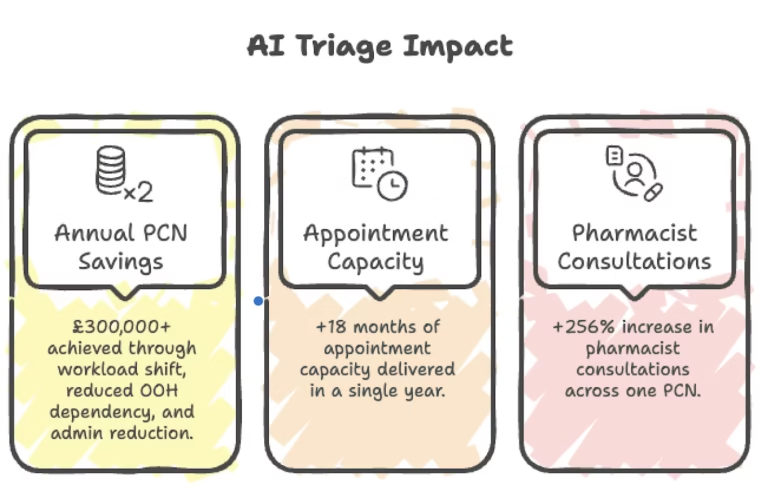
These results show that AI triage doesn’t just improve access it expands system capacity.
3. Before and After: The Patient Perspective
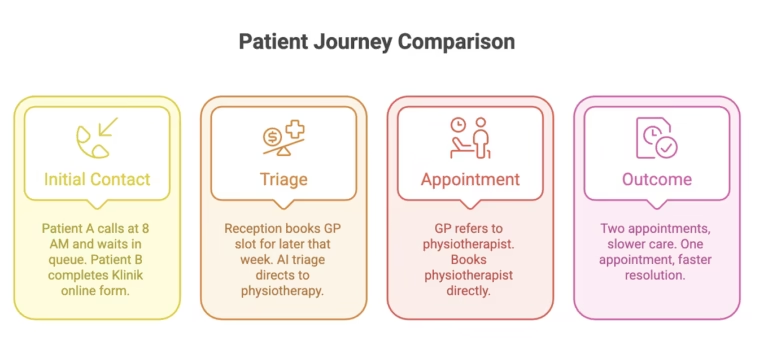
For the patient, it’s the difference between waiting to be seen and being seen right away.
Reorganising Healthcare Around Patients, Not Processes
Klinik isn’t just a software tool it’s a new operating model for primary care. By applying structured data and clinically validated AI, it replaces the outdated scramble for appointments with an intelligent, equitable system centred on patient need.
Primary care no longer has to run on a first-come, first-served basis. With Klinik, every patient gets guided like a plane in safe hands to the right care, from the right professional, at the right time.
FAQ
How does Klinik ensure patient safety?
The system’s AI is clinically validated and CE-marked. Every recommendation is reviewed by a trained triage team before action.
What training do staff need to use it?
Reception and clinical teams can be fully trained in under a day, thanks to structured workflows that mirror everyday processes.
Is Klinik suitable for all practice sizes?
Yes. It scales effortlessly from single practices to multi-site PCNs, adapting to existing clinical capacity.
How quickly are results visible?
Most practices report measurable impact such as reduced clinician workload and faster patient access within the first month of deployment.